Download Language Font Free For Android
One of the best things about Android is just how customizable it is. Android phones let you personalize them to your heart’s content in order to improve the experience and express yourself. Changing fonts for Android seems like a logical extension of this philosophy, though it isn’t always as straightforward as you might expect. The good news is that where there is a will, there is a way! Read on to learn how to change fonts for Android!
Some phones already have it built in!
While stock Android (still) lacks the ability to customize your system font, plenty of manufacturers have adapted their software to support this highly requested feature. Companies like Samsung, HTC, and LG all make it easy to change fonts for Android.
The process may change depending on your specific handset, but you can normally find this option in the settings, usually under the “Display” section. From there you can change the actual font, as well as the font size.
For instance, nearly all Samsung Android devices let you change the font style. Samsung has pre-installed a few extra fonts besides the default one, but you can get more online through the Galaxy Store (both free and paid).
Total Downloads: 1796; Publisher: somyac; Licence model: Freeware; Language: English; Release date:; All versions of Font Manager. Font Manager is a free app for the Android by somyac which can replace the system fonts of your phone with another beautiful fonts, 15 types in total in which you can easily.
Free Fonts For Android
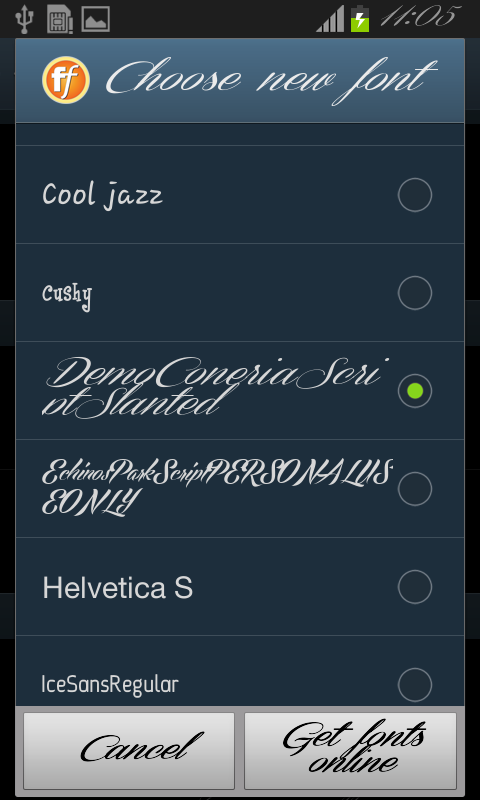
Selecting a font requires a quick trip to Settings > Display > Font size and style. Just tap the name of the font that you want and confirm that you want to set it as a system font. Font replacement is instantaneous; no need for rebooting. The selected font will be displayed throughout your device’s interface such as the time on the status bar, system menus, and even in your text messages.
Changing fonts for Android with apps and launchers
If you can’t change your font system-wide, then a useful trick to change fonts for Android is to install a custom launcher. This will replace your main home screen and will often be able to affect other UI elements across the system as well. By customizing your fonts this way, you’ll change the way your device looks most of the time. Failing that, there are a couple of apps that will let you manually change your fonts for Android. We’ll explore our top picks below.
Read more: Best launcher apps for Android
Apex Launcher
One of the most popular third-party launchers is Apex Launcher. As shown in our video, here’s how to change fonts on your phone’s home screen after you download and install Apex Launcher. Keep in mind that this will only change fonts within the launcher itself and that the app is fairly expensive.
- Go into the settings of Apex Launcher.
- Tap the “Home Screen” selection.
- Tap the “Layout and Style” option.
- Finally, tap the “Label Font” selection and pick which font you want to use for your home screen.
If you want to change the font on your app drawer, there’s another method to do so via Apex Launcher:
- Go into the settings of Apex Launcher.
- Tap the “App Drawer” selection.
- Tap on the “Drawer Layout & Icons” option.
- Finally, scroll down and then tap the “Label Font” selection and pick which font you want to use for your app drawer.
Finally, you can change the font for your phone’s folder in this manner with Apex Launcher:
- Go into the settings of Apex Launcher.
- Tap on the “Folder” selection.
- Finally, scroll down and then tap on the “Label Font” selection and pick which font you want to use for your folder.
GO Launcher
GO Launcher is a launcher aimed specifically at those users who like to customize their phones. That includes changing fonts. To change font styles in GO Launcher, do the following:
- Copy your TTF or OTF font files to your phone.
- Long press anywhere on the home screen and select “GO Settings.”
- Choose Font > Select Font.
- Pick your font, or tap “Scan” to add files stored on your device.
This won’t change the fonts system-wide, but it will change them across the app, which will include most of the menus and apps you’ll interact with regularly.
Action Launcher: Pixel Edition
Download Free Fonts For Android Tablet
Another powerful launcher when it comes to Android customization is the excellent Action Launcher: Pixel Edition. To change your font using Action Launcher, head into the settings and then choose Appearance > Font. Now choose the font you want. You won’t have a huge selection here, just the system fonts and a few variations, but it’s still better than nothing!
- Go into the settings of Action Launcher.
- Head to Appearance > Font.
- Choose a font you want to use and you’re done.
Smart Launcher 5
Smart Launcher 5 is another launcher that will let you select new fonts for Android. This time, you’ll head into the settings and then choose Global appearance > Font. There’s a very decent selection of fonts available in Smart Launcher, which is great for those that really want to express themselves. It’s just a shame that once again the change is only going to impact the fonts that are in the app.
- Go into the settings of Smart Launcher 5.
- Head to Global appearance > Font.
- Choose a font you want to use and you’re done.
iFont
- Select a font
- Tap “Download”
- Tap “Set”
iFont is not a launcher, but rather an app specifically used to change fonts for Android. It is completely free and supports many Samsung, Xiaomi Meizu, Huawei, HTC, Sony, and Motorola rooted handsets.
On non-rooted devices, use iFont’s Online tab to browse for available fonts. To use a font on the list, do the following:
- Enable installation of apps from “Unknown Sources.” This option can usually be found in Settings > Security.
- Launch iFont and go to the “RECOM” or “FIND” tabs to find fonts.
- Tap on a font name that you want to install.
- Tap the “Download” button.
- Tap the “Set” button to install the font.
- Go to Settings > Display > Font Size and Style. Your newly installed font should appear on the list.
- Tap on the new font to use it as the system font.
- The font is applied immediately. No reboot needed.
You can also copy TrueType fonts (TTF) from your PC to the /sdcard/ifont/custom directory; the fonts will then appear on the “Custom tab.” But to be able to install and use the fonts, you will need a rooted device.
Unfortunately, the trade-off is that Samsung One UI does not seem to support iFont anymore (at least this writer could not get it to work). You may, therefore, find that newer Samsung devices don’t work. An alternative does exist, however, and it’s called Wings Samsung Fonts.
While many people will be happy sticking with the default fonts for Android, being able to customize them is a great option for those that like to personalize their gadgets. This flexibility is part of the appeal of Android. The good news is that no matter what type of device you own, there should be some way to set your own font. And now you know how to start!
Those who are a bit more tech-savvy can change fonts manually on rooted devices using the Android Debug Bridge (ADB), among other options, but we’re not going to go into detail on how to do it in this post.
What font is splattered all over your Android device’s UI today? Have you ever changed your fonts for Android to something else? Let us know in the comments below!
Android 8.0 (API level 26) and Android Support Library 26 introduce support for APIs to request fonts from a provider application instead of bundling files into the APK or letting the APK download fonts. The feature is available on devices running Android API versions 14 and higher through the Support Library 26.
The Downloadable Fonts feature offers the following benefits:
- Reduces the APK size
- Increases the app installation success rate
- Improves the overall system health as multiple APKs can share the same font through a provider. This saves users cellular data, phone memory, and disk space. In this model, the font is fetched over the network when needed.
Refer to the following related resources:
How does Downloadable Fonts work?
A font provider is an application that retrieves fonts and caches them locally so other apps can request and share fonts. Figure 1 illustrates the process.
The basics
You can use the Downloadable Fonts feature in the following ways:
Using Downloadable Fonts via Android Studio and Google Play services
You can set your application to download fonts by using Android Studio 3.0 or higher. To help you get started with the Downloadable Fonts features, you can use the font provider from Google Play services.
Note: A device must have Google Play services version 11 or higher to use the Google Fonts provider.
- In the Layout Editor, select a TextView, and then under Properties, select fontFamily > More Fonts.
The Resources window appears.
- In the Source drop-down list, select Google Fonts.
- In the Fonts box, select a font.
- Select Create downloadable font and click OK.
Note: To bundle the font in your app, select Add font to project.
Android Studio automatically generates the relevant XML files that are needed to render the font correctly in your app.
Using Downloadable Fonts programmatically
Prior to Android 8.0 (API level 26), the Support Library 26.0 provides full support for Downloadable Fonts. For more information about using the support library, go to the Downloadable Fonts support library section.
To use the Downloadable Fonts feature programmatically, you need to interact with two key classes:
android.graphics.fonts.FontRequest: This class lets you create a font request.FontsContract: This class lets you create a newTypefaceobject based on the font request.
Your app retrieves fonts from the font provider by using the FontsContract API. Each provider has its own set of restrictions on the Android versions and query language it supports. For more information on the Android versions and query format, refer to your provider’s documentation.
To download a font, perform the following steps:
- Create an instance of the
android.graphics.fonts.FontRequestclass to request the font from the provider. To create a request, pass the following parameters:- The font provider authority
- The font provider package to verify the identity of the provider
- The string query of the font. For more information about query formats, see your font provider's documentation, such as Google Fonts.
- A list of sets of hashes for the certificates to verify the identity of the provider.
Note: There is no need to add a certificate if you request fonts from pre-installed providers. However, you must always provide a certificate if you request fonts through the support library.
Note: You can receive the parameter values from your font provider. Android Studio automatically populates these values for the providers it supports in its UI.
- Create an instance of the
FontsContract.FontRequestCallbackclass. - Override the
onTypefaceRetrieved()method to indicate the font request is complete. Provide the retrieved font as the parameter. You can use this method to set the font, as needed. For example, you can set the font on aTextView - Override the
onTypefaceRequestFailed()method to receive information about errors in the font request process. For more information about error codes, refer to theerror code constants. - Call the
FontsContract.requestFont()method to retrieve the font from the font provider. The method initiates a check to determine if the font exists in the cache. If the font is not available locally, it calls the font provider, retrieves the font asynchronously, and passes the result to the callback. Pass the following parameters:- an instance of the
Contextclass - an instance of the
android.graphics.fonts.FontRequestclass - a callback to receive the results of the font request
- a handler to fetch fonts on a thread
Note: Ensure this handler is not the User Interface thread handler.
- an instance of the
The following sample code illustrates the overall Downloadable Fonts process:
For more information about how to download a font from a font provider, go to Downloadable Fonts sample app.
Using Downloadable Fonts via the support library
The Support Library 26 provides support to the Downloadable Fonts feature on devices running Android API versions 14 or higher. The android.support.v4.provider package contains FontsContractCompat and FontRequest classes to implement the backward-compatible Downloadable Fonts feature support. The support library classes contain methods similar to framework. The process of downloading fonts is also similar to the one mentioned in the Downloading fonts section.
To download fonts by using the support library, import the FontsContractCompat and FontRequest classes from the android.support.v4.provider package. Create the instances of these classes instead of FontsContract and android.graphics.fonts.FontRequest framework classes.
Note: You must provide a certificate when you request fonts through the support library. This is applicable even for the pre-installed font providers.
Adding support library dependency
To use the FontsContractCompat and FontRequest classes, you must modify your app project's classpath dependencies within your development environment.
To add a support library to your application project:
- Open the
build.gradlefile of your application. - Add the support library to the
dependenciessection.
Using Downloadable Fonts as resources in XML
Android 8.0 (API level 26) and Support Library 26 offer a faster and more convenient way to declare a custom font as a resource in the XML layout. This means, there is no need to bundle the font as an asset. You can define a custom font for your entire theme, which accelerates usability for multiple weights and styles, such as Bold, Medium, or Light, when provided.
- Create a new XML file in the
res/fontfolder. - Add
<font-family>root element and set the font-related attributes as shown in the following sample XML file: - Refer to the file as @font/font_file_name in the layout XML file. You can also use the
getFont()method to retrieve the file programmatically. For example,getFont(R.font.font_file_name).
Pre-declaring fonts in the manifest
Layout inflation and resource retrieval are synchronous tasks. By default, the first attempt to retrieve fonts triggers a request to the font provider, and therefore increases the first layout time. To avoid the delay, you can pre-declare fonts that need retrieving in your manifest. After the system retrieves the font from the provider, it is available immediately. If the font retrieval takes longer than expected, the system aborts the fetching process and uses the default font.
To pre-declare fonts in the manifest, perform the following steps:
- Create a resources array in
res/values/arrays.xmland declare the Downloadable Fonts that you want to prefetch. - Use a
meta-datatag to declare the resource array in your manifest.
Adding certificates
When a font provider is not preinstalled or if you are using the support library, you must declare the certificates the font provider is signed with. The system uses the certificates to verify the font provider's identity.
Note: Android Studio can automatically populate the values for the Google Play services provider if you use the font selector tool in Android Studio. For more information about using Android Studio for downloading fonts, go to the Using Downloadable Fonts via Android Studio and Google Play services section.
Perform the following steps to add certificates:
- Create a string array with the certificate details. For more information about certificate details, refer to your font provider's documentation.
- Set the
fontProviderCertsattribute to the array.
Note: If the provider has more than one set of certs, you can define an array of string arrays.