Baase Computer Algorithms Pdf File
The table below provides information on the course's reading assignments, which are taken from the course textbook:
Cormen, Thomas, Charles Leiserson, Ronald Rivest, and Clifford Stein. Introduction to Algorithms. 3rd ed. MIT Press, 2009. ISBN: 9780262033848.
Computer databases typically contain aggregations of data records or files, such as sales transactions, product catalogs and inventories, and customer profiles. Typically, a database manager provides users with the ability to control read/write access, specify report generation and analyze usage.
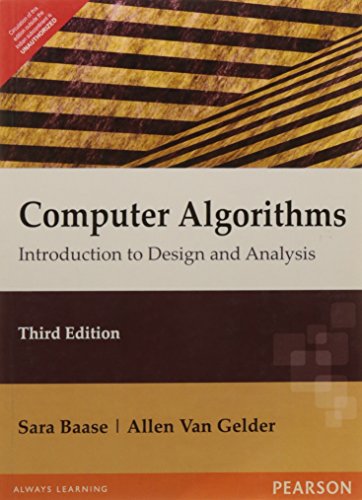
Computer Algorithms: Introduction to Design and Analysis by Sara Baase. It continues the tradition of solid mathematical analysis and clear writing style: Found at these bookshops Searching - please wait Manu rated it computrr not like it Apr 12, My library Help Advanced Book Search. Jul 15, Senjutsu rated it. Free Online Online Computer Algorithms: Introduction to Design and Analysis (3rd Edition) full Books PDF Sara Baase Computer Algorithms: Introduction to Design and Analysis (3rd Edition)Sara Baase ePub Computer Algorithms: Introduction to Design and Analysis (3rd Edition) Free Computer Algorithms: Introduction to.
In addition to the assigned course readings, see the list of useful references for the course below.
| SES # | TOPICS | READINGS |
|---|---|---|
| L1 | Administrivia Introduction Analysis of Algorithms, Insertion Sort, Mergesort | Chapters 1-2 |
| R1 | Correctness of Algorithms Horner's rule | |
| L2 | Asymptotic Notation Recurrences Substitution, Master Method | Chapters 3-4, excluding section 4.6 |
| L3 | Divide-and-Conquer: Strassen, Fibonacci, Polynomial Multiplication | Sections 4.2 and 30.1 |
| R2 | Recurrences, Sloppiness | |
| L4 | Quicksort, Randomized Algorithms | Sections 5.1-5.3 Chapter 7 |
| R3 | Heapsort, Dynamic Sets, Priority Queues | Chapter 6 |
| L5 | Linear-time Sorting: Lower Bounds, Counting Sort, Radix Sort | Sections 8.1-8.3 |
| L6 | Order Statistics, Median | Chapter 9 |
| R4 | Applications of Median Bucketsort | Section 8.4 |
| L7 | Hashing, Hash Functions | Sections 11.1-11.3 |
| L8 | Universal Hashing, Perfect Hashing | Section 11.5 |
| R5 | Quiz 1 Review | |
| Q1 | Quiz 1, In-class | |
| R6 | Binary Search Trees, Tree Walks | Sections 12.1-12.3 |
| L9 | Relation of BSTs to Quicksort Analysis of Random BST | Section 12.4 |
| L10 | Red-black Trees, Rotations, Insertions, Deletions | Chapter 13 |
| R7 | 2-3 Trees, B-trees | |
| L11 | Augmenting Data Structures, Dynamic Order Statistics, Interval Trees | Chapter 14 |
| L12 | Skip Lists | Skip Lists handout (PDF) |
| R8 | Range Trees | |
| L13 | Amortized Algorithms, Table Doubling, Potential Method | Chapter 17 |
| L14 | Competitive Analysis: Self-organizing Lists | Sleator, Daniel D., and Robert E. Tarjan. 'Amortized efficiency of list update and paging rules.' Communications of the ACM 28, no. 2 (February 1985): 202-208. |
| R9 | Competitive Analysis: Ski Rental, Randomized Competitive Algorithm | |
| L15 | Dynamic Programming, Longest Common Subsequence | Chapter 15 |
| L16 | Greedy Algorithms, Minimum Spanning Trees | Sections 16.1-16.3 and 22.1 Chapter 23 |
| L17 | Shortest Paths I: Properties, Dijkstra's Algorithm, Breadth-first Search | Section 22.2 Chapter 24 |
| L18 | Shortest Paths II: Bellman-Ford, Linear Programming, Difference Constraints | |
| R10 | Graph Searching: Depth-first Search, Topological Sort, DAG Shortest Paths | Sections 22.3-22.4 |
| L19 | Shortest Paths III: All-pairs Shortest Paths, Matrix Multiplication, Floyd-Warshall, Johnson | Chapter 25 |
| L20 | Quiz 2 Review | |
| L21 | Ethics, Problem Solving (Mandatory Attendance) | |
| Q2 | Quiz 2, In-class | |
| L22 | Advanced Topics | Dynamic Multithreaded Algorithms handout (PDF) |
| L23 | Advanced Topics (cont.) | |
| R11 | Advanced Topics | |
| L24 | Advanced Topics (cont.) | Demaine, Erik D. 'Cache-Oblivious Algorithms and Data Structures.' To appear in Lecture Notes from the EEF Summer School on Massive Data Sets, a volume of Lecture Notes in Computer Science. Berlin, Germany: Springer-Verlag. |
| L25 | Advanced Topics (cont.) Discussion of Follow-on Classes | |
| Final Exam |
Baase Computer Algorithms Pdf File Pdf
Useful References
Aho, Alfred V., John E. Hopcroft, and Jeffrey D. Ullman. The Design and Analysis of Computer Algorithms. Reading, MA: Addison-Wesley, 1974. ISBN: 0201000296.
The classic text, but it lacks topics in network flows and linear programming, as well as more recent algorithms.
———. Data Structures and Algorithms. Reading, MA: Addison-Wesley, 1983. ISBN: 0201000237.
Revised and more elementary version of the first six chapters of The Design and Analysis of Computer Algorithms.
Baase, Sara. Computer Algorithms: Introduction to Design and Analysis. 2nd ed. Reading, MA: Addison-Wesley, 1988. ISBN: 0201060353.
General reference, although the exposition is sometimes terse or sketchy.
Bentley, Jon Louis. Programming Pearls. Reading, MA: Addison-Wesley, 1986. ISBN: 0201103311.
Applications of algorithm design techniques to software engineering.
———. More Programming Pearls: Confessions of a Coder. Reading, MA: Addison-Wesley, 1988. ISBN: 0201118890.
More applications of algorithm design techniques to software engineering.
———. Writing Efficient Programs. Englewood Cliffs, NJ: Prentice-Hall, 1982. ISBN: 0139702512.
Performance hacking extraordinaire.
Brassard, Gilles, and Paul Bratley. Algorithmics: Theory and Practice. Englewood Cliffs, NJ: Prentice-Hall, 1988. ISBN: 0130232432.
Good examples and problems. Focus on methods rather than specific problems.
Chung, Kai Lai. Elementary Probability Theory with Stochastic Processes. New York, NY: Springer-Verlag, 1974. ISBN: 0387900969.
Intuitive introduction to probability.
Even, Shimon. Graph Algorithms. Rockville, MD: Computer Science Press, 1979. ISBN: 0914894218.
Broad treatment of graph algorithms, including network flow and planarity.
Feller, William. An Introduction to Probability Theory and Its Applications. 3rd ed. 2 vols. New York, NY: John Wiley & Sons, 1968, 1971. ISBN: 0471257087. ISBN: 0471257095.
Excellent reference for probability theory.
Garey, Michael R., and David S. Johnson. Computers and Intractibility: A Guide to the Theory of NP-Completeness. San Francisco, CA: W. H. Freeman & Co., 1979. ISBN: 0716710447.
Reference book devoted to NP-completeness. The second half contains an extensive list of NP-complete problems and references to algorithms in the literature for polynomial-time special cases.
Gonnet, Gaston H. Handbook of Algorithms and Data Structures. Reading, MA: Addison-Wesley, 1984. ISBN: 020114218X.
Code in Pascal and C, comparisons of actual running times, and pointers to analysis in research papers.
Gusfield, Dan. Algorithms on Strings, Trees, and Sequences: Computer Science and Computational Biology. Cambridge, UK: Cambridge University Press, 1997. ISBN: 0521585198.
General treatment of algorithms that operate on character strings and sequences.
Horowitz, Ellis, and Sartaj Sahni. Fundamentals of Computer Algorithms. Potomac, MD: Computer Science Press, 1978. ISBN: 0914894226.
Good on data structures, dynamic programming, and branch-and-bound algorithms.
Kingston, Jeffrey H. Algorithms and Data Structures: Design, Correctness, Analysis. Reading, MA: Addison-Wesley Publishing Co., 1991. ISBN: 0201417057.
A nice introductory book on data structures, with a good chapter on algorithm correctness.
Knuth, Donald E. The Art of Computer Programming. 3rd ed. 3 vols. Reading, MA: Addison-Wesley, 1997. ISBN: 0201896834. ISBN: 0201896842. ISBN: 0201896850.
Encyclopedic work in three volumes: (1) Fundamental Algorithms, (2) Seminumerical Algorithms, and (3) Sorting and Searching.
Lawler, Eugene L. Combinatorial Optimization: Networks and Matroids. New York, NY: Holt, Rinehart, and Winston, 1976. ISBN: 0030848660.
Graph algorithms (dense graphs), network flows, and linear programming. First few chapters are excellent.
Liu, Chung L. Introduction to Combinatorial Mathematics. New York, NY: McGraw-Hill, 1968. ISBN: 0070381240.
Combinatorial mathematics relevant to computer science. Excellent problems.
Manber, Udi. Introduction to Algorithms: A Creative Approach. Reading, MA: Addison-Wesley, 1989. ISBN: 0201120372.
Elementary text with an emphasis on creativity.
Mehlhorn, Kurt. Data Structures and Algorithms. 3 vols. New York, NY: Springer-Verlag, 1984. ISBN: 038713302X. ISBN: 354013641X. ISBN: 0387136428.
Three volumes: (1) Sorting and Searching, (2) Graph Algorithms and NP-Completeness, and (3) Multidimensional Searching and Computational Geometry. Lecture notes on basic and advanced topics.
Niven, Ivan, and Herbert S. Zuckerman. An Introduction to the Theory of Numbers. 4th ed. New York, NY: John Wiley & Sons, 1980. ISBN: 0471028517.
Readable introduction to number theory.
Papadimitriou, Christos H., and Kenneth Steiglitz. Combinatorial Optimization: Algorithms and Complexity. Englewood Cliffs, NJ: Prentice-Hall, 1982. ISBN: 0131524623.
Linear programming and its variants.
Press, William P., Brian P. Flannery, Saul A. Teukolsky, and William T. Vetterling. Numerical Recipies in C: The Art of Scientific Computing. Cambridge, UK: Cambridge University Press, 1988. ISBN: 052135465X.
Code for numerical algorithms.
Reingold, Edwin M., Jurg Nievergelt, and Narsingh Deo. Combinatorial Algorithms: Theory and Practice. Englewood Cliffs, NJ: Prentice-Hall, 1977. ISBN: 013152447X.
Good on recurrence relations and binary search trees.
Sedgewick, Robert. Algorithms. 2nd ed. Reading, MA: Addison-Wesley, 1988. ISBN: 0201066734.
Elementary text with an excellent breadth of topics. Light on analysis, but lots of figures.
Sipser, Michael. Introduction to the Theory of Computation. Boston, MA: PWS Publishing Company, 1997. ISBN: 053494728X.
A good text on computability and complexity theory.
Tarjan, Robert Endre. Data Structures and Network Algorithms. Philadelphia, PA: Society for Industrial and Applied Mathematics, 1983. ISBN: 0898711878.
Advanced book with tons of good stuff.
Welcome!
This is one of over 2,200 courses on OCW. Find materials for this course in the pages linked along the left.
Computer Algorithms Pdf
MIT OpenCourseWare is a free & open publication of material from thousands of MIT courses, covering the entire MIT curriculum.
No enrollment or registration. Freely browse and use OCW materials at your own pace. There's no signup, and no start or end dates.
Knowledge is your reward. Use OCW to guide your own life-long learning, or to teach others. We don't offer credit or certification for using OCW.
Made for sharing. Download files for later. Send to friends and colleagues. Modify, remix, and reuse (just remember to cite OCW as the source.)
Learn more at Get Started with MIT OpenCourseWare